Every year, hundreds of workers suffer serious injuries—or worse—because machinery was accidentally energized during maintenance. The solution isn’t complicated, but it is precise: proper lockout tagout (LOTO) procedures. When followed correctly, LOTO saves lives. When ignored or misapplied, it leads to preventable tragedies.
This isn’t just about hanging a tag or turning off a switch. Proper LOTO is a systematic process designed to isolate energy sources, secure equipment, and communicate control status across teams. Whether you're on a factory floor, in a utility plant, or managing maintenance crews, understanding and executing LOTO correctly is non-negotiable.
What Is Lockout Tagout and Why It Matters
Lockout tagout refers to the practice of de-energizing machinery or equipment and preventing accidental startup through the use of locks and warning tags. It's a formalized safety procedure required by OSHA under standard 29 CFR 1910.147. The goal? To protect employees from unexpected release of hazardous energy—electrical, mechanical, hydraulic, pneumatic, chemical, or thermal.
Consider this real-world example: A technician climbs into a conveyor system for routine belt adjustment. A coworker, unaware of the work, resets a tripped breaker. The conveyor jerks to life. The outcome can be catastrophic.
Proper LOTO stops such incidents by ensuring: - All energy sources are isolated - Equipment is rendered inoperable - Only the authorized employee can restore power
It’s not just about compliance. It’s about creating a culture where safety is procedural, not situational.
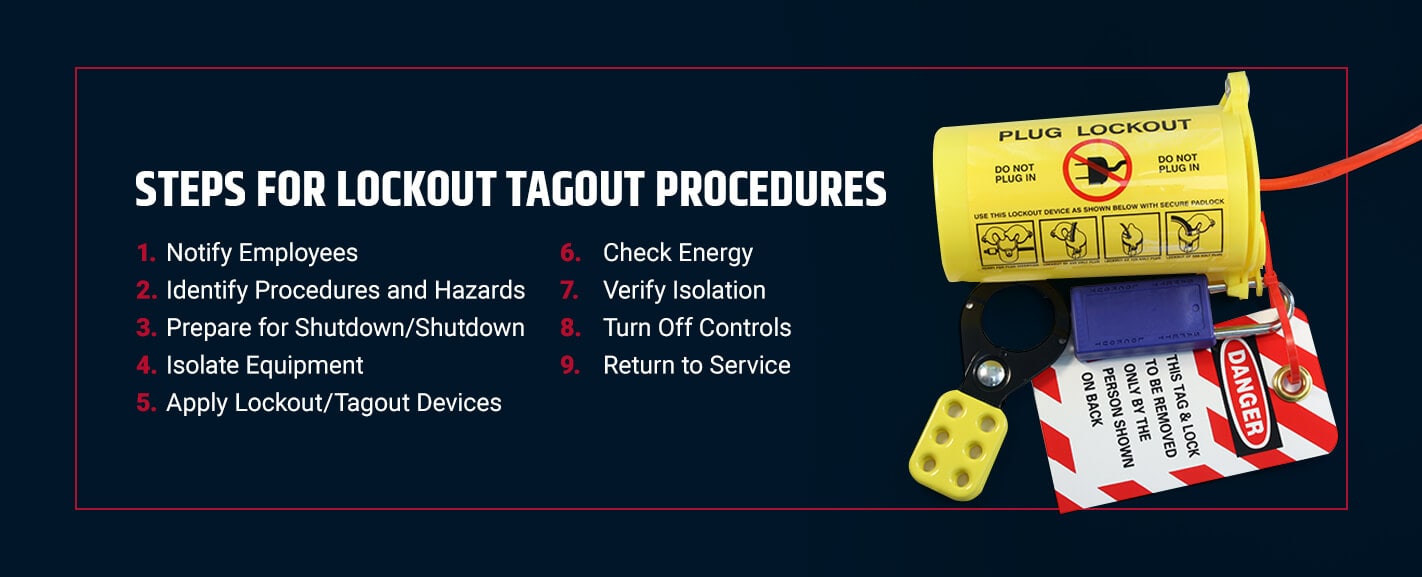
The 7-Step Lockout Tagout Procedure
While specific workflows vary by equipment and industry, a universally effective LOTO process follows seven core steps. Deviating from any one step introduces risk.
1. Prepare for Shutdown
Before any work begins, authorized employees must identify the type and magnitude of energy used by the machine, as well as the associated hazards. This includes reviewing equipment-specific LOTO procedures and gathering required tools—locks, tags, isolators, and personal protective equipment (PPE).
Common Mistake: Skipping the prep phase leads to incomplete isolation. For example, failing to recognize a secondary hydraulic reservoir can leave stored energy uncontrolled.
2. Notify Affected Personnel Communication is critical. Anyone who operates or uses the equipment must be informed of the upcoming shutdown and maintenance. This step prevents confusion and discourages unauthorized attempts to restart.
3. Shut Down the Equipment Use normal stopping procedures—no shortcuts. Press emergency stops only in emergencies; they don’t isolate energy and shouldn’t be relied on for LOTO.
4. Isolate All Energy Sources
This is the heart of LOTO. Locate and physically disconnect every energy source: - Electrical: circuit breakers, disconnect switches - Pneumatic: valve closures, bleed lines - Hydraulic: pressure release valves - Mechanical: spring tension release, gravity blocks

Realistic Use Case: On a large industrial press, isolating energy may involve locking out the main power disconnect, closing and locking hydraulic valves, and inserting a physical block to prevent ram descent.
5. Apply Locks and Tags Each authorized employee applies their own lock and tag. Use a hasp if multiple workers are involved. Tags must include: - Name of the locking employee - Date and time of lockout - Reason for LOTO
The lock is personal—only the employee who applied it can remove it. No sharing keys. No master overrides without strict authorization and verification.
6. Release Stored Energy Even after isolation, energy may remain—compressed air, elevated parts, capacitors, or chemical residues. Safely dissipate or block this energy. Verify zero-energy state by attempting to restart (briefly and safely) after isolation.
Workflow Tip: Always double-check with a voltage tester or pressure gauge. Assumptions kill.
7. Verify Isolation Attempt to start the machine using normal controls. If it operates, the LOTO failed. Reassess isolation points. Only when the machine fails to start—safely and under controlled conditions—can maintenance begin.
Common LOTO Mistakes That Risk Lives
Even experienced teams make errors. Recognizing these frequent failures helps prevent them:
- Using one lock for multiple people — Each worker must have their own lock.
- Skipping tag information — Tags without names or dates are meaningless.
- Failing to control all energy sources — Missing a secondary line or backup battery is a deadly oversight.
- Assuming “off” means “safe” — Control circuits can be live even when equipment is off.
- Rushing verification — Skipping the try-start step is one of the most common violations.
Example: In a 2019 incident at a Midwest packaging plant, a worker was fatally crushed when a robotic arm lowered unexpectedly. The LOTO procedure had only locked the main electrical panel, ignoring the pneumatic system’s stored air pressure. The stored energy was never released.
Roles and Responsibilities in LOTO
Clear roles eliminate ambiguity.
Authorized Employees
These are trained personnel who physically implement LOTO. They:
- Understand energy types and hazards
- Know how to isolate and secure machines
- Apply and remove their own locks
Affected Employees Operators who use the equipment but don’t perform maintenance. They must: - Recognize LOTO devices - Never attempt to restart locked-out equipment - Report violations
Employer Responsibilities Employers must:
- Develop written LOTO procedures for each machine
- Provide training annually
- Conduct periodic inspections (at least yearly)
- Enforce compliance
Insight: A routine inspection should involve a full walkthrough of the LOTO process with an authorized employee. Observers check for compliance gaps, not just documentation.
Equipment-Specific LOTO Challenges Not all machines are the same. Some present unique challenges.
Conveyor Systems Multiple energy sources, long shutdown times, and remote sections require zone-based LOTO. Use group lockout boxes where each technician places their lock before entry.

Robotic Cells Automated systems often have backup batteries, networked controls, and remote activation. Isolate at the main power source and disable safety interlocks only under supervision.
HVAC Units These may have electrical, refrigerant, and fan systems. Lock out disconnects, secure dampers, and tag refrigerant valves.
Chemical Processing Equipment Beyond energy isolation, these require line breaking procedures and atmospheric testing. Lockout must coordinate with confined space entry protocols.
Tip: Maintain machine-specific LOTO checklists at or near the equipment. Quick access improves accuracy.
Best Tools and Devices for Effective LOTO Using the right hardware enhances reliability and clarity. Here are five essential tools:
| Tool | Purpose | Real-World Use |
|---|---|---|
| Lockout Hasps | Allow multiple locks on one isolation point | Group maintenance on a shared conveyor |
| Valve Lockouts | Secure ball, gate, or butterfly valves | Prevent accidental gas flow in pipelines |
| Circuit Breaker Locks | Prevent resetting of breakers | Isolate electrical panels during panel work |
| Tagout Tags | Communicate lock status and owner | Warn others not to disturb isolated equipment |
| Group Lockout Stations | Centralize locks and tags for teams | Used in plant-wide shutdowns |
Pro Tip: Color-code locks by department or energy type. Red for electrical, blue for pneumatic. Visual cues reduce errors.
OSHA Compliance and Audits
OSHA doesn't just recommend LOTO—it mandates it. Non-compliance can result in fines exceeding $15,000 per violation. Worse, it exposes companies to liability after incidents.
To stay compliant: - Maintain written procedures for every piece of equipment - Train employees annually and document it - Inspect each LOTO procedure at least once per year - Correct deficiencies immediately
During an audit, OSHA will: - Review your energy control program - Observe a live LOTO demonstration - Interview employees on their understanding
Limitation: Many companies treat LOTO as paperwork, not practice. Audits reveal gaps between policy and real-world execution.
Building a LOTO Culture, Not Just Compliance
The most effective LOTO programs go beyond rules—they build habits.
- Start meetings with LOTO reminders
- Recognize employees who report near-misses
- Post visual LOTO flowcharts near high-risk machines
- Empower workers to stop work if procedures are bypassed
Example: A food processing plant reduced maintenance incidents by 70% after introducing LOTO “safety champions” on each shift. These peer leaders conducted mini-audits and coached colleagues.
When LOTO becomes routine—like wearing a seatbelt—compliance follows naturally.
Final Steps to Ensure LOTO Success
Proper lockout tagout procedures aren’t complicated, but they demand discipline. Start by auditing your current process. Are procedures machine-specific? Are tags complete? Are stored energy sources addressed?
Train relentlessly. Inspect regularly. Empower every worker to question unsafe actions.
LOTO isn’t a box to check—it’s a promise. A promise that no one will be hurt because a machine turned on when it shouldn’t have. Follow the steps, respect the process, and protect your team, every time.
Frequently Asked Questions
What’s the difference between lockout and tagout? Lockout uses physical locks to prevent energizing equipment; tagout uses warning tags. Lockout is preferred, but tagout can be used when energy isolation devices aren’t designed for locks—provided additional safety measures are in place.
Can a supervisor remove a lock if the employee is absent? Only under strict conditions: documented attempts to contact the employee, verification that they’re not at the facility, and approval by authorized personnel following a formal unlock procedure.
How often should LOTO procedures be reviewed? At least annually, and whenever equipment changes or an incident occurs.
Who can perform lockout tagout? Only authorized employees who have received specific training and are responsible for servicing or maintaining equipment.
Do LOTO procedures apply to corded plug equipment? Yes. If the plug is under the exclusive control of the employee and unplugging fully de-energizes the machine, the plug can be locked out with a simple device.
Is training required for workers who don’t perform maintenance? Yes. Affected employees must be trained to recognize LOTO devices and understand not to operate locked-out equipment.
Can multiple energy sources use one lockout point? No. Each energy source must be isolated individually. A single lockout point may exist for convenience (e.g., lockout box), but each source must be verified as isolated.
FAQ
What should you look for in Mastering Proper Lockout Tagout Procedures for Workplace Safety? Focus on relevance, practical value, and how well the solution matches real user intent.
Is Mastering Proper Lockout Tagout Procedures for Workplace Safety suitable for beginners? That depends on the workflow, but a clear step-by-step approach usually makes it easier to start.
How do you compare options around Mastering Proper Lockout Tagout Procedures for Workplace Safety? Compare features, trust signals, limitations, pricing, and ease of implementation.
What mistakes should you avoid? Avoid generic choices, weak validation, and decisions based only on marketing claims.
What is the next best step? Shortlist the most relevant options, validate them quickly, and refine from real-world results.